
This data is a copyright of Korean brain science research, and is protected according to copyright law.Unauthorized replication, battery and distribution.


The human brain is constantly changing, and functional improvements can be achieved through proper stimulation and training. The Korea Research Institute of Brain Science is scientifically verifying the effectiveness of neurofeedback training based on electroencephalogram (EEG) analysis technology that can precisely measure the brain's electrophysiological activity.
This case study is an analysis report based on the brainwave changes before and after training of an 11-year-old boy. The boy was suffering from poor concentration and sleep problems, and received 30-minute training five times a week for a total of two months.
The training was conducted using the following protocol:
- 1:1 customized neurofeedback training
- Providing feedback based on real-time brainwave monitoring
- Focusing on stabilizing the autonomic nervous system and inducing beta wave activity
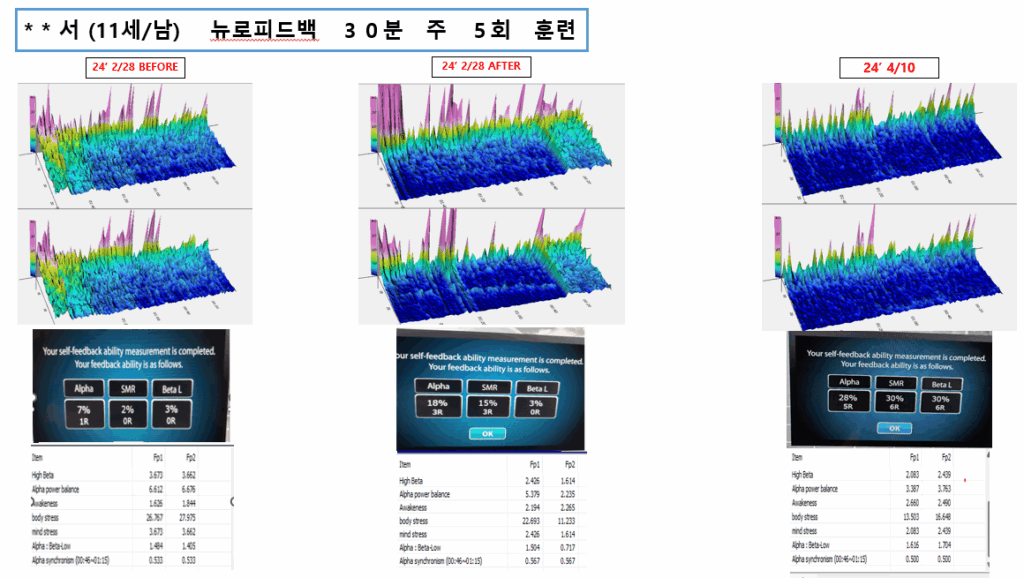
📊 1. Pre-training EEG analysis
As a result of analyzing EEG data measured before the start of training, the following characteristics were confirmed:
- Reduced SMR wave/beta wave activity → Weakened concentration and executive function → 집중력 및 실행 기능 약화
- Excessive distribution of theta wave → Emotional instability, tendency to be distracted
- Left-right brain asymmetry → Inefficient brain function
- Reduced self-regulation ability → Weak self-directed learning ability
🧪 2. Brain wave changes immediately after the first training day
As a result of measuring brain waves immediately after completing the first training, the following positive reactions were confirmed in just 30 minutes:
- Decreased theta waves → Increased arousal
- Increased alpha wave ratio → Increased ease of entering a state of rest and relaxation
- Improved self-regulation ability → Improved emotional control ability
📈 3. Brain wave changes after 2 months (effect of continuous training)
The brain wave data measured after 2 months of continuous neurofeedback training were significantly different from the initial state:
- Overall brain wave balance recovery → stabilization of left and right brain activity
- Continuous beta wave activity → improved ability to maintain concentration in daily life
- Suppression of stress response → increased autonomic nervous system stability, improved sleep quality
- Improved self-regulation ability → induction of true self-directed learning and improved ability to regulate emotions
🔬Conclusion: Neurofeedback training can lead to functional changes in the brain
This case study shows that neurofeedback training leads to mental health and measurable physiological changes. In particular, since the results are based on quantitative EEG analysis, they are highly reliable and reproducible.
The Korea Research Institute of Brain Science is continuously accumulating such EEG-based training data and utilizing it to develop personalized solutions. In the future, we will continue to present scientific evidence for brain optimization based on real data targeting various age groups and symptom groups.
Related Inquiries
For inquiries about neurofeedback training or customized tests, please contact brainscience_korea@naver.com.